Tuesday, 23 July 2013

Bringing Up Baby


I don’t usually bird very much in July but this year poor weather in May and June and some family travels left many holes in my year list.  In the past three weeks I have made day trips to Water Valley, Banff, Waterton and some local sloughs. 
While the birding is definitely better in June there are still lots of interesting birds to be seen in the summer.  Juvenile birds – particularly the water birds – are easy to spot and sometimes come in quite different plumages than their parents.
Pied-Billed Grebe juvenile
Pied-Billed Grebe adult
This Pied-Billed Grebe juvenile got separated from its parents and the adult could be heard calling for its young.  Eventually the two were reunited.  At the same slough east of Calgary, this American Coot had three lovely chicks following it around.
American Coot with three young
Eared Grebes (Black-necked Grebes to my European friends) have a strategy to keep the young one nearby – the juvenile rides on the back of the adult.  Pretty soon the young bird is too big and has to swim on its own.

Eared Grebe with young on back
Eared Grebe with young
Sometimes the young do look like one of the parents as evidenced by this female Ruddy Duck and six ducklings.
Ruddy Duck female with ducklings
It always amazes me how fast the young grow and that they can be larger than their parents.  These two young dippers in Waterton created quite a racket anytime the parent came near.  Notice how much smaller the adult (in the water) looks.
American Dipper juveniles pestering their parent
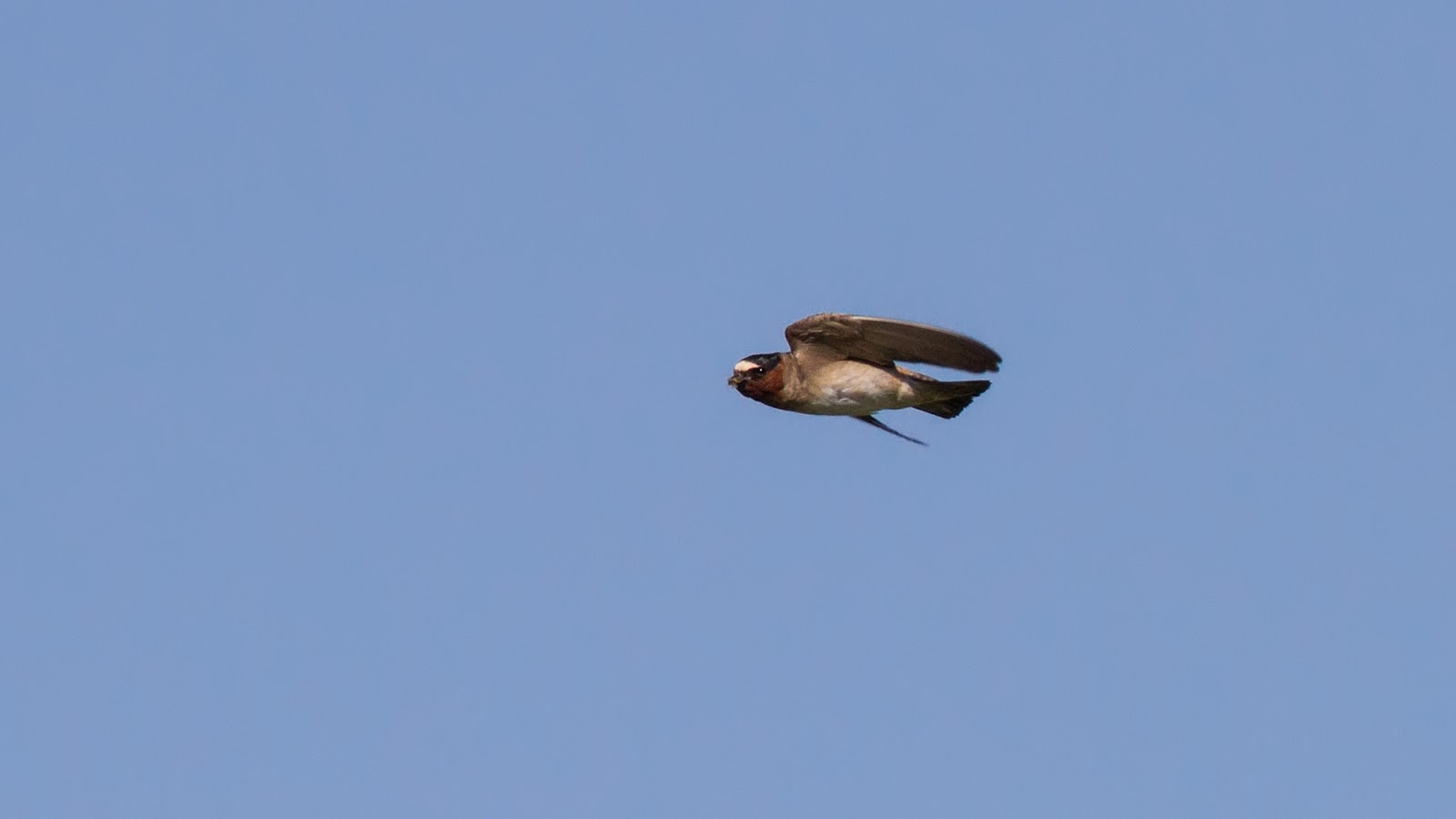
Feeding the young seems to be a full-time job (at least for one parent).  Here are a couple of birds carrying food back to their young.  The young tern then went for a short flight after being fed.
Cliff Swallow
Black Tern
Black Tern feeding young
Black Tern juvenile
There comes a time when the young have to fend for themselves though they will often chase the parent around begging to be fed.  This young male Yellow-headed Blackbird is now independent whether he likes it or not.
Yellow-headed Blackbird juvenile male
Surprisingly, there was still a reasonable amount of song activity … perhaps the males were hoping to start a second brood or perhaps they were still looking for their first love.  Lazuli Bunting in Waterton and Tennessee Warbler in Water Valley were two species still singing.
Lazuli Bunting
Tennessee Warbler
Despite the parenting theme to this blog, I could resist including a photo of a dark-phased Swainson’s Hawk (perhaps it was looking for food to feed its young?).  The white undertail coverts are the quickest way to differentiate this bird from the Red-tailed Hawk - our other common hawk.
Swainson's Hawk
I hope these photos encourage you to get out and do some birding this summer.

Brian

Saturday, 6 July 2013

Focus on breeding birds

By the beginning of June, most of Alberta’s migrants have reached their breeding grounds, either here or further north though there are still a few laggards such as Yellow-bellied Flycatcher which take their time getting here and some shorebirds (such as the Sanderling below) which aren’t in any hurry to reach the Arctic.

Sanderling
Cold Lake/Meadow Lake trip – June 2-5

Ray Woods and I made a quick trip to Cold Lake early in June to look for some of the boreal forest birds that aren’t as common around Calgary. On our way, we visited Charlotte, aka “the prairie birder”, in Vermilion. We birded with her near her farm and saw some good birds including a Common Nighthawk which was a lifer for her … always nice to get a lifer in your front yard (it’s been many years since I’ve had the pleasure).
Ray, Charlotte and me (notice Charlotte's "I just got a lifer look"?)
Charlotte's first Common Nighthawk
We made one more stop before reaching Cold Lake – Kehiwin Lake – to look for Great Crested Flycatcher.  No luck with the flycatcher but we did get some nice views of Philadelphia Vireo.
Philadelphia Vireo
Monday morning, we birded Cold Lake Provincial Park focusing on warblers.  We had some success finding Canada, Blackburnian and Magnolia Warblers and a few others.  Later that morning we enjoyed seeing Sedge Wrens near the Saskatchewan border.
Canada Warbler
Blackburnian Warbler
Sedge Wren
The Primrose Lake road to the west of Cold Lake is another good birding spot.  We traveled it twice – once in the afternoon and again the next morning.  It took us a while but we eventually found most of the expected birds with highlights being Cape May and Connecticut Warblers.  Also of interest was a nesting pair of Ospreys which took to the air when we walked by.

Typical habitat northwest of Cold Lake
Osprey
That afternoon, we returned to the park to look for a couple of birds we missed the first time round.  Chestnut-sided Warblers proved easy once we looked in the right place (thanks to info from Bob Storms) but Mourning and Bay-breasted Warblers still eluded us.
Chestnut-sided Warbler
Across the border in Saskatchewan (SK), Meadow Lake Provincial Park looked like a good place to build up our Saskatchewan list so we spent Tuesday afternoon and Wednesday morning in the area before heading home.  We did record a number of new SK birds but found that the birding wasn’t as good as on the Alberta side. 

On the way home, we stopped at a site where Ray had seen Piping Plovers many years ago and found one running along the shore. 
Piping Plover

Piping Plover breeding sites are treated much differently in Alberta than on the east coast of Canada.  Here in Alberta, the sites are not publicized (participants in plover viewing field trips are sworn to secrecy) and visiting the sites is discouraged; last year on les Iles de la Madelaine, a breeding site on a beach was demarcated with a rope fence about 15m square (I’m sure the unleashed dogs paid close attention to the ropes).  It seems to me that an approach somewhere between these extremes would be more appropriate.

Day trips from Calgary – June 10 & 12th

Isaac Sanchez is doing a photographic North America birding big year and I volunteered to show him some of our local birds. On the 10th, Isaac, Bob Storms and I birded the Brooks area (a 2 hour drive to the east). We had mixed success finding about ½ of Isaac’s target birds with the highlight being close looks at a Sprague’s Pipit (usually just a speck in the sky). Another highlight for me was an American Badger that Bob spotted … if you followed last year’s blog, you’ll remember the difficulty we had finding this species.

Sprague's Pipit
American Badger
Isaac’s targets included some common species such as Franklin’s Gull and Black Tern.  It’s always nice to have some easy targets and also to practise flight shots.  A couple of days later, I met up with Isaac and his wife in the Water Valley area (40 minutes northwest of Calgary) and we found a few more of his targets including Great Gray Owl.
Franklin's Gull
A grasslands day trip – July 2
The 2nd half of June was busy with a trip to B.C. to visit family and getting some carpet installed (a lot more work than my wife and I anticipated).  The birds are usually starting to quiet down by the beginning of July but Ray Woods and I wanted to get out birding.  Reports of a Black-billed Cuckoo in the Finnegan area (about 1 ½ hours to the east of Calgary) was our incentive and we set off early on July 2. 
We didn’t find the cuckoo but did find a number of new year birds including Lark Sparrow, Yellow-breasted Chat, Burrowing Owl and Grasshopper Sparrow.

Burrowing Owl
The long drive back featured a couple on pleasant distractions – roadside Upland Sandpipers and a young Mule Deer buck with velvety antlers.
Upland Sandpiper


Mule Deer
A brief note on the recent southern Alberta floods
Barb and I live in one of the highest parts of Calgary so were not affected by the terrible floods that hit Calgary and surrounding areas.  Mike Mulligan (one of the Fur & Feathers 500 birders) lives near the Bow River but fortunately his home didn’t suffer any water damage.  As you may have seen on the news, many others weren’t quite so fortunate … I can only imagine the grief the flooding caused (though thankfully with very little loss of life) and hope that everyone can get their lives back to normal as soon as possible.  I also hope that the governments and communities can start taking steps to ensure that this disaster is not repeated.   Bird life and bird habitat was also impacted by the flooding but birders are reporting that the birds are showing as much resiliency as the human population.


Next up?  
July and the first couple of weeks in August are usually pretty quiet but the shorebirds should be returning and there is plenty of water around.  I will also be making a trip to B.C. – primarily for golf but there is always a chance of a new mammal or two.
Good birding and mammaling,

Brian

Thursday, 30 May 2013

Alberta in the merry month of May

After a seven week hiatus, I return to the world of blogging.  Here in Alberta, May really marks the beginning of spring and the return of the migratory birds.  As always, we try to urge the birds northward before they are ready and then, in the blink of an eye, migration is over.

The month began with a visit from my friends, Alistair and Sveta.  Alistair is a photographer who is becoming a birder and I had hoped to show him many new birds.  They had seen the movie “The Big Year” and their only target bird was a Great Gray Owl and I’m happy to report that we saw two of them. 
We birded in the Calgary region for a few days and it seemed like I was forever saying “normally there the birds should be back” or “there will be lots of birds here in a couple of weeks”.  We did find a few interesting birds such as Yellow-bellied Sapsucker, American Three-toed Woodpecker, and Gray-crowned Rosy-Finch and had a Moose wander across the road.
Yellow-bellied Sapsucker
American Three-toed Woodpecker
Gray-crowned Rosy-Finch
Moose
The weekend of May 4th & 5th, my wife and I drove our guests up to Jasper National Park.  I didn’t expect to see many birds (and we didn’t) but had high expectations of seeing many interesting mammals.  “Normally there should be …” but mammals were few and far between.  We did see a distant Mountain Goat but no bears – there bears were just coming out of hibernation and there were only scattered reports of sightings.  However, the wonderful scenery kept us captivated and no one was too disappointed with the lack of wildlife.  At the roadside viewpoints, we also enjoyed close views of inquisitive Common Ravens and Clark's Nutcrackers.
Mountain Goat
Atop Whistlers Mountain near Jasper
Typical scenery along the Banff-Jasper Highway
Common Raven
Clark's Nutcracker
You can view Alistair's photos of his trip to Alberta at: http://alistair.zenfolio.com/recent.html.
The second week in May usually marks the beginning of the shorebird migration and I had ideas of doing a blog just on shorebirds.  A Purple Sandpiper was found – an Alberta first record - by Eddie Matoud and it stayed around long enough for most local birders to see it.
Purple Sandpiper in early morning light
There was lots of suitable habitat for the shorebirds and we had a brief but decent migration.  Of course, for an acceptable photo, the birds need to be close enough and in the right light.  The rarer species such as White-rumped Sandpiper weren’t so cooperative but some of the common species such as Stilt Sandpiper and Marbled Godwit were more obliging.
Stilt Sandpiper
Marbled Godwit
About a week ago, the weather turned nasty – cold, wet and windy – but that’s not enough to keep one at home.  While searching unsuccessfully for a vagrant Tri-colored Heron that had been seen a couple of days earlier, I came across these Cliff Swallows huddled together.
Cliff Swallows trying to stay warm
The last weekend in May is the date for Alberta’s annual May Species Count.  Ray Woods and I were assigned an area in the far northwest of the Calgary area region (a 50 mile radius circle centered in central Calgary), an area we had done a few times before.  On Saturday, the weather was still pretty bad as evidenced by this soggy Great Horned Owl.
Great Horned Owl
Over the two day count period, we had 102 species which is a little below normal.  The only real highlight was an Arctic Tern (a new Alberta bird for me) but it was so distant that we only confirmed identification afterwards by studying our photos.  Of course, it is always nice to see a breeding plumaged Sandhill Crane.
Sandhill Crane
With May coming to a close, Phil Cram and I tried to re-find the Arctic Tern last Tuesday.  No luck but we did enjoy nice views of some returning summer residents such as Le Conte’s Sparrow and Western Tanager.
Le Conte's Sparrow
Western Tanager
June will be a busy month with trips to the Cold Lake area for birding and to B.C. to visit friends and family. 
With all of the inclement weather in recent weeks, I made good progress compiling my world mammal list.  My total is 300 mammals which, combined with 3826 birds, puts me at 4126 fur & feathers … only 874 to go!

Good birding,
Brian


Wednesday, 10 April 2013

Northward Bound ... Why???

Three weeks ago I was northward bound, leaving the southern hemisphere and leapfrogging millions of migrating birds.  We spent 7 delightful weeks in Argentina (and a couple of days in Chile) and had great weather for most of the trip.  I arrived back in Canada for the first day of spring and had high hopes that the migrants wouldn’t be too far behind … HAH!   As I should know, in Calgary the spring calendar and spring weather aren’t coordinated - emphatically reinforced by the wintry conditions for the past three weeks.  

Still, one mustn’t be deterred by the weather so I have been birding a few times.  The first was a visit to the Water Valley area to the northwest where there was a decent mix of resident birds [Great Gray Owl], winter residents [Northern Shrike, Rough-legged Hawk] and migrants [American Tree Sparrow].
Great Gray Owl
My next two trips were to the south: Ray Woods and I had a nice daytrip to Waterton and, a couple of days later, I went as far as Claresholm with Phil Cram and Mike Mulligan. Around Calgary, lakes are still covered by ice but we found some open water to the south. We saw many species of ducks crowding any available open water but nothing unusual. Richardson’s Ground Squirrels were now appearing in the fields and this brought the return of Ferruginous Hawks.

Ferruginous Hawk

Ferruginous Hawk

Before the last storm hit, I drove east looking to photograph some ducks.  They all were very skittish when I approached on foot so the only decent shots I got were taken from my vehicle.  I also enjoyed observing different mannerisms of the ducks such as their take-off methods.  As shown below, the Northern Pintail explodes upwards from the water whereas the Common Goldeneye runs along the water (or ice) before taking flight.
Northern Pintail

Common Goldeneye
During last year’s big year, we went birding regardless of the weather; this year I find that I am much more selective with my outings.  Similarly, the big year blog had to be written otherwise we would fall too far behind; this year, my blogs have been sporadic with little focus on my distant end target of 5000 species.  While waiting for the birds to come back, I am hoping to make some progress compiling my mammal list so I will at least know how far I have to go.

Good birding,
Brian